Showing posts with label Daily 5. Show all posts

Wednesday, November 5, 2014

Words Their Way

Even during my first year teaching (not so long ago) I was uneasy about assigning a spelling list every Monday and testing every Friday. It felt like a throwback, the only thing in my classroom that resembled what I did in elementary school decades ago. It was very easy to plan for and parents seemed to appreciate the predictability, but those are really the only things in its favor.

Anyone who has taught spelling this way will tell you that certain students will ace any spelling test, while others will struggle on any. Those in between tend to earn scores that reflect how well they studied. But nobody seemed to remember how to spell those 10-20 words after test day, let alone others that follow the same pattern. Differentiating for these students was often little more than cutting the list down or adding to it.

My limited experience with Words Their Way has already improved on this model. I knew this year's class included a great many students who needed extra help and just as many (if not more) who needed an extra challenge. And in any classroom, we need to be teaching every student at his or her level. 

After I gave the benchmarking test (called an inventory) I found that most of my students fell into two large groups with the rest in a few very small groups. Each group works on a word sort. I haven't had too much trouble keeping track of who's doing what, just using a Google spreadsheet helps me see who is using what list. 

Different teachers handle the practice and assessment differently, but the Words Their Way program includes all the word sorts for each level, and unit assessments for each unit. At the end of the week, I have the students glue their sort into place, so I'm still assessing them weekly. Students who score 80 percent or above move on to the next sort. Those who have trouble can repeat their sort the next week and get some extra help.

A lot of teachers will make up a weekly schedule of things to do with the sorts. I perused some of these but none of them seemed to fit well with what we were doing. Right now, nearly all of my students are sorting cards with only pictures on them. Soon they'll have a mix of words and pictures, but for now I don't see the value in having everyone rainbow write their words when they haven't seen the correct spelling. Ultimately, I don't spend a lot of class time on the sorts. My students pull them out and work on them first thing in the morning, which I love. I have struggled forever to come up with a "bellringer" activity that was more than just busy work. This way they get differentiated instruction that involves zero extra photocopying and grading. 


They also can use them for Word Work during the Daily 5. Then they can take a stab at rainbow writing them or spelling them with magnetic letters. I also pull groups to work with me on their sorts at this time.

Otherwise, they do their practice games at home, on their own time. A lot of teachers have made excellent homework contracts for Words Their Way and many of them are free on TpT. I just made this one because I wanted something that was designed to work with the picture sorts. I made one almost like it for word sorts to make an easy transition once we start seeing more of those.

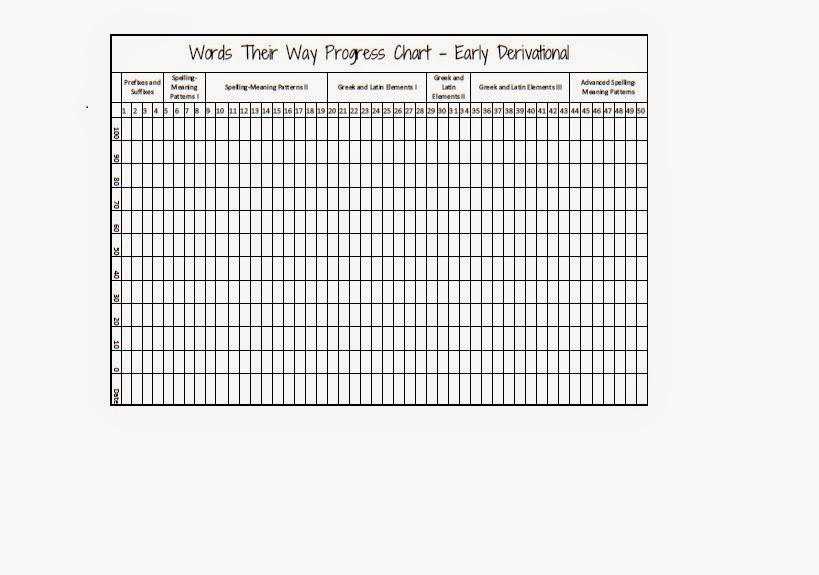
I also made up a progress chart for one set of sorts. I found some good ones for Letter Name-Alphabetic sorts and Words Within Words sorts at this TpT store, but couldn't find one for my little friend who is working in Early Derivational sorts (yes, this is first grade!) So I made something very similar. This is for those of you looking for a way to keep track of your Words Their Way progress in Data Binders.

 WTW - Early Derivational Progress Chart
Sorry this isn't prettier...it's looks better in person!
Happy sorting!


Friday, August 1, 2014

Five for Friday! {with a freebie}

Linking up with Doodle Bugs again for Five for Friday. Let's roll!


By Friday night last week I had both my new laminator and color ink in my possession. So I did what any young, energetic person with an exciting life does on a Friday night. I stayed up until (almost) midnight printing, laminating and cutting. I got some awesome goodies from A Sunny Day in First Grade and First Grade Fairy Tales, plus I finally got to print and hang my "I Can" statements!


Reading Literature and Informational Text standards near the CAFE menu.

Reading Foundational Skills near the word wall and some of the Word Work choices.


I also have a writing bulletin board where I hung the writing standards, but somehow my phone purged that photo. Still trying to figure out where to hang the Speaking/Listening and Language standards. I may split the Foundational Skills standards into even smaller groups so I can post certain standards near the word work students do to reinforce them.

I use these little magazine holders from IKEA for book boxes for Daily 5. They definitely are not as sturdy as plastic ones but are much cheaper and easier to find. I bought all the plastic ones on sale at Target today for $3 -- they only had six! And they don't seem to sell them except during back to school season. My amazing paraprofessional spent a ton of time reinforcing them with colorful duct tape. A lot of them held up really well, others needed more reinforcing at the end of the year. They had been taking up an entire countertop, so I bought these white shoe shelves at Target. They are $14 but you can get them for $12 with Cartwheel. I needed three to hold 25 book boxes. In case you're wondering if they are strong enough to hold an average sized woman while she hangs something up high...

they're not. Thank goodness for Cartwheel.

Added plus, they give me two extra sets of shelves below for storing Daily 3 math stuff, and I have that whole countertop to do...something with.


This year will be my fourth year teaching. Where I am, that means I have been pink slipped three times. This past year went a lot better than the others because I got rehired before the year was out. It's been amazing to have the end of the year and the whole summer to get ready for next year. And truth be told, my (fantastic) classroom paraprofessional did a ton of the work at the end of the year. The biggest project was a class set of OWL binders!

Cover
 

Rules and guidelines.

I can't take credit for the idea. The other first grade teacher and her former colleague had been doing these for years before I came along. She gave me everything she used, and I just put my own little twist on it.

Making these last summer was how I got really indoctrinated into the notion of an organized classroom. I always figured I was pretty organized, or organized enough. But these blew my mind.

They have a zippered pencil pouch, the planner that the school buys, and a homework folder. Then there are two sections in the back set off by cardstock dividers. One is for all the various calendars (behavior, reading, snack), the other is for sight words, quarter by quarter. And everything is labeled with freaking labels.

The kids have exactly one thing to pack up every day. The parents have exactly one thing to check every night. I have exactly one thing to check every morning. It has revolutionized a lot of what I deal with and don't have to deal with day to day. I am now debating what to have the kids do first thing in the morning while I stamp. What do you do to start the day?

Being at home for the summer never fails to impart some domestic lessons. Among these:

  • Krazy Straws that go through the dishwasher cease to be Krazy.
  • If the living area of your house is 50% carpet, and your cat coughs up a hairball five days a week, the hairball will be found on the carpet roughly 100% of the freaking time.
  • If rain doesn't fall from the sky without provocation, you must actually step onto your deck and water your plants. 
  • On the scale of difficult tasks, vacuuming a living room bursting with tiny plastic food, a rainbow of Duplos, and Thomas the Tank Engines of every possible size falls somewhere between alligator wrestling and nuclear fusion.

You made it to the freebie! Three cheers for stamina.

My district does Continuous Improvement/Quality Tools. The gist of it is that students are aware of and accountable for their own achievement. One of the ways we promote and track this is through Data Centers. 

A Data Center is a bulletin board with charts where your class tracks its achievement on various measures. Last year I had four charts: behavior, math assessments, weekly spelling tests, and reading (sight words). My room is owl themed (can you believe it?!) so these charts are too.


It's all in Google docs for you to play with.
The math chart is based on a 20 unit schedule. This is my master plan for next year, though I confess being frightened. Another teacher in my district has made some amazing assessments for each of these units, and you should really check out her blog while you're at it.

First Grade Common Core Math Assessments Bundle


Have a fabulous weekend!


Mrs. F-W

Tuesday, July 29, 2014

How do you teach math? I, We, You vs. You, Y'all, We

Math is a touchy subject for me. I excelled in math in school -- until I didn't. Our district let students skip ahead a grade in math if we did well, even to the point of busing us to the middle school and the high school when we were in 6th and 8th grades. So when I started floundering as a freshman in what my school called Honors Algebra 3-4, I fell off the honors math track and had trouble landing anywhere. I'll spare you the dull details of my circuitous journey through my school's tracked math courses and just sum up by saying I (and my parents) could not understand why math was a snap for me for nine years, and then I suddenly started failing.

I began piecing together what might have happened nearly 15 years later when I was taking my math pedagogy course. In my late twenties I was finally learning the concepts behind all those algorithms that only got more confusing with each year. The class was amazing and it left me with a lot of big ideas about how I wanted to do things in my classroom once I finally had one. Teaching concepts, then letting the algorithms reveal themselves as students honed their own problem solving strategies.

But when I did finally get a job, the students had already been in school for three days. I had to hit the ground running, so I started from square one with the district curriculum, branching out and adding on little by little as I got more comfortable. When I moved to first grade last year, I did the same. I was essentially winging it in my ELA curriculum by stepping away from our lackluster language arts curriculum and teaching CAFE and Daily 5. So I leaned on the math curriculum once again, which was quite a bit different in the primary grades.

Math became my least favorite time of day. Each lesson was set up with a math meeting/calendar time (which I was able to do my own way), fact practice that ate up a ton of time, a very teacher-centered scripted lesson, and "guided practice" that was a big worksheet we all did together. The students struggled to stay with me through the whole thing as I struggled to differentiate my instruction and cram everything in to the hour or so we had for math each day. That hour fell between lunch and specials (art, music, library, PE) that took us right up to dismissal, so nobody was exactly bursting with energy at that point either.

I am resolving to start anew this year, to teach concepts and to structure my math block like my literacy block: with time for independent and cooperative learning, and for differentiated instruction with strategy groups. I am mining EngageNY and other resources for lesson plans and trying to learn as much as I can about Daily 3 math. If you have experience with either, I'd love to hear about it. I also read this yesterday:

Why Do Americans Stink at Math? By Elizabeth Green for the New York Times.
The headline is a little bit of clickbait, to be sure, but the story is fascinating. A teacher in Japan revamps his instructions based on the recommendations of a consortium of educators in America. It's referred to here as "You, Y'all, We," meaning students are given a problem to grapple with, to give them an opportunity to apply what they already know (You). Then they share their thinking with groups or partners and compare notes (Y'all). Finally the class discusses the solutions as a whole group (We). 

This is contrary to the popular (old-fashioned) method like the one my curriculum uses, referred to as "I, We, You." The teacher demonstrates how to solve a problem (I). The class tries the teacher's methods with support from the teacher or other students (We). The students work independently -- this is a large chunk of the instructional time that mainly boils down to practicing a series of similar problems (You). 

The teacher trying the You, Y'all, We method goes on to get amazing results and trains other teachers who experience similar results. Then he comes to teach in America, only to find that we (American teachers) are using none of these same methods. Why? The sources in the story posit a few ideas: uneven training, turnover, unclear expectations for teachers. The recommendations are from NCTM, or the National Council of Teachers of Mathematics, which has been busy since the 1980s coming up with these ideas.

Obviously, Common Core State Standards have a much broader reach. Unless you are in one of the two states that haven't adopted them, they are a big part of your professional life right now. I think Common Core, especially the Standards for Mathematical Practice, ought to reinforce this type of teaching. But, as the article point out, it's suffering from some serious implementation issues. Teachers all over the U.S. are being asked to develop their own curriculum with very little guidance. OK. I think we are capable. But if our new curriculum is to represent a serious shift in how we teach, we need to clearly understand what it should look and sound like. Anyone, whether it's a large producer of educational materials or a teacher with a TpT store, can say that their materials are aligned to the Common Core. Slapping that label on it doesn't make it so. Just because a lesson, product, or "activity" touches on some of the ideas in the standards doesn't mean it represents meaningful instruction or creates real opportunities for learning.

How do we shed the skin of teacher-centered, dull lessons and meaningless busy work? What type of support do teachers need to put these practices into action? What has worked for you in your classroom?

Friday, July 25, 2014

Five for Friday


Today I'm trying out my first Five for Friday by linking up with DoodleBugs. I picked a crazy week to debut -- I can't say they'll always be this eventful!

A major upheaval in my worldview led me to the conclusion that my house needs a command center. I'll truncate a long and boring tale by saying that I lived a long time in denial of the fact that I needed any level of organization. We have a small house with an open floor plan, an unusual combination that has led to eight years of paper flotsam accumulating in the corners of all the countertops, on all unoccupied kitchen chairs, and even the bedroom closet. Something had to change.

If you're reading a teacher blog, I don't have to explain to you the power of Pinterest to inform us of all the domestic things we had no idea we were supposed to be doing. Don't get me started on how this targets women and the gendered expectations to which we are held. But the command center intrigued me right away.

I have looked and looked and looked at other peoples command centers, like this one and this one. I had to scale it down to my level (differentiating, you know). And this is what I came up with. Ta da!

View from above.

Organizing papers.
Lettering!


Basket o' bags.

Pens, coupons, etc.


I cannot believe I actually got it done -- and in one nap! This is why I only have one kid. OK, this and a few other reasons.

I got as much as I could in the One Spot at Target: buckets, letter stickers. The picture frame at the top (which still needs pictures) was about three dollars. I got this one for two dollars:


I just flipped the cardboard inside to the back and used the letter stickers, then stuck Command hooks on the glass.

The mesh cups and big file are from Staples (and way overpriced, but I couldn't track them down anywhere else). The whiteboard we'd had for years but was buried under a pile of papers on the fridge.

You may have heard this elsewhere, but it's really true: if I can do it, literally anyone can.


This one is from the parenting files. My son is just over two years old. Potty training has hit a serious wall, but hope springs eternal. I thought maybe it might be smart to move little man over to a toddler bed in anticipation of the day that he rises from bed, realizes he needs to go, and takes himself to the potty. WHOA dream big.

So on Tuesday night, this happened.

The point of no return.
Mr. W bought a camera so we could watch the action. At first, I couldn't tear myself away from the video feed on my phone. We'd never used a video monitor so I was unaccustomed to this much information about what went on after we put the little guy to bed. But time passed, he fiddled around...and then went to sleep. That's it! He woke up once with a bad dream, but just stood up in his bed and yelled just like he did when he was in his crib. I hugged him and put him back down and he went right back to sleep.

In the morning, he usually wakes up and sings and chatters long enough for me to hop in the shower. I wasn't sure how that would work out on Wednesday morning. So I turn on the video feed, then the shower...and he instantly wakes up. I watched and watched, and he seriously just sat there in bed looking around. I kept waiting and waiting for hijinks to ensue and they just did not. So I took a shower and eventually he started asking when we were coming. At one point before I was, ahem, ready to head into his room, Mr. W walked in to say goodbye on his way to work and told him he could get up and start playing. Only then did he wander over to his toy box and stand next to it.

I just hope this continues when school starts.


I finally dragged myself back into my classroom to do some physical work. I've been busting my butt from home in as many ways as I could think of until now. But it was time. The little man is going to a new day care next year, and I wanted us to try it out a few times before he goes full time. And I am planning some big changes for next year and needed to start doing the summer shuffle.

First up, Daily 5. Last year was my first in first grade, and my first with Daily 5. It took a lot of trial and error to get to a good place with it. One thing I never quite got how I wanted it was the procedure of getting everyone to whatever their choice was. I know some teachers just assign, some rotate groups, etc. But I really wanted to preserve the student choice aspect of it because I think it's really important. But I also wanted some control over how many kids ended up in one place and to make sure the kids were truly changing up their activities, without micromanaging.

I ended up putting a choice board up on the SMART Board with each kid's name and a certain number of spaces for each area. One student would draw names until everyone had a turn. I was able to start my strategy group while the others were choosing their area and getting settled. That was great. What was not so great was that the students in line would go bananas until they got to the board, where they would stand and stare for several minutes until they could finally choose something. And because it's a SMART Board, only one student could choose at a time and everyone else had to wait (and continue to go bananas with ever-increasing volume). I had a 15-minute timer on the board, and it could take up to 8 minutes for all the kids to get settled.

This year I am going low tech. I want kids to have a sense of urgency to choose their activity (before it fills up!) and I want several to choose at a time. So I'm still planning on having a student pull names on popsicle sticks, however, now students will take their popsicle stick where they want to work. Each activity is getting a little library pocket for the sticks.

These are the Word Work choices, with some of the portable (desk) activities right below.
The little pockets are in packs of 10 at Dollar Tree. I got some colored popsicle sticks at a garage sale, so I'm thinking of doing a color for each rotation.


I was very much hoping to have photos of my "I Can" Statements posted in my room in time for today. No such luck: I'm still waiting on the color ink I ordered to get here. I guess I'll just have a printing party this weekend, because I did get this:

Squee!
I don't know what having my own laminator says about me, but I guess I'll take it! I got a Word Work banner from a Sunny Day in First Grade that I'm really excited about, and plans for some other things I need to create.


So for my fifth thing, I will just have to casually remind you of the majesty of my I Can statements, and hopefully next week they'll be hanging up all over my room!

Written to make sense to you and your students.
I have reorganized my Word Work area, where I can hang the Reading Foundations standards, and my Writing area, phonemic awareness area...you get the idea! I have report covers galore and just need to track down some binder rings. 

Have a fabulous weekend!

Mrs. F-W