Showing posts with label best practices. Show all posts

Sunday, June 14, 2015

Math workshop/Daily 3

Last year I tried to implement Daily 3 math, but I'll admit I struggled. I was teaching EngageNY lessons without really knowing much about them and trying to get a routine going. I also was just going on what was on the 2 Sisters site because I don't have the newest edition of The Daily Five. I had a lot of false starts. In January, I started piloting what has become our district's new math curriculum, McGraw Hill's My Math. I found that the structure of the lessons gave me good opportunities to get back into a workshop model. Because it was so late in the year, I sort of defaulted to a very simple workshop model with five math groups and five centers and hopefully by the end of the week, everyone got to go everywhere.

This year I hope to give it another shot. I'm still not feeling really confident about Daily 3, but I think I can improve my math workshop. I've been pinning math games like a crazy person and cooked up one that will put all those dollar spot flash cards to use.


I always buy flash cards when I find them for a dollar but have yet to find a way to put them to good use. I'm hoping this will give my students a way to support one another in fact fluency and give them an engaging way to practice. Pick it up here:


Wednesday, November 5, 2014

Words Their Way

Even during my first year teaching (not so long ago) I was uneasy about assigning a spelling list every Monday and testing every Friday. It felt like a throwback, the only thing in my classroom that resembled what I did in elementary school decades ago. It was very easy to plan for and parents seemed to appreciate the predictability, but those are really the only things in its favor.

Anyone who has taught spelling this way will tell you that certain students will ace any spelling test, while others will struggle on any. Those in between tend to earn scores that reflect how well they studied. But nobody seemed to remember how to spell those 10-20 words after test day, let alone others that follow the same pattern. Differentiating for these students was often little more than cutting the list down or adding to it.

My limited experience with Words Their Way has already improved on this model. I knew this year's class included a great many students who needed extra help and just as many (if not more) who needed an extra challenge. And in any classroom, we need to be teaching every student at his or her level. 

After I gave the benchmarking test (called an inventory) I found that most of my students fell into two large groups with the rest in a few very small groups. Each group works on a word sort. I haven't had too much trouble keeping track of who's doing what, just using a Google spreadsheet helps me see who is using what list. 

Different teachers handle the practice and assessment differently, but the Words Their Way program includes all the word sorts for each level, and unit assessments for each unit. At the end of the week, I have the students glue their sort into place, so I'm still assessing them weekly. Students who score 80 percent or above move on to the next sort. Those who have trouble can repeat their sort the next week and get some extra help.

A lot of teachers will make up a weekly schedule of things to do with the sorts. I perused some of these but none of them seemed to fit well with what we were doing. Right now, nearly all of my students are sorting cards with only pictures on them. Soon they'll have a mix of words and pictures, but for now I don't see the value in having everyone rainbow write their words when they haven't seen the correct spelling. Ultimately, I don't spend a lot of class time on the sorts. My students pull them out and work on them first thing in the morning, which I love. I have struggled forever to come up with a "bellringer" activity that was more than just busy work. This way they get differentiated instruction that involves zero extra photocopying and grading. 


They also can use them for Word Work during the Daily 5. Then they can take a stab at rainbow writing them or spelling them with magnetic letters. I also pull groups to work with me on their sorts at this time.

Otherwise, they do their practice games at home, on their own time. A lot of teachers have made excellent homework contracts for Words Their Way and many of them are free on TpT. I just made this one because I wanted something that was designed to work with the picture sorts. I made one almost like it for word sorts to make an easy transition once we start seeing more of those.

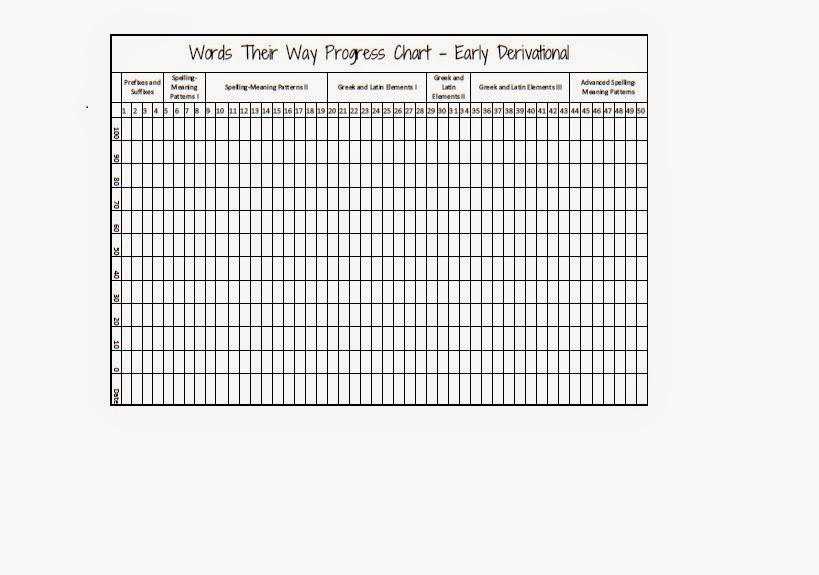
I also made up a progress chart for one set of sorts. I found some good ones for Letter Name-Alphabetic sorts and Words Within Words sorts at this TpT store, but couldn't find one for my little friend who is working in Early Derivational sorts (yes, this is first grade!) So I made something very similar. This is for those of you looking for a way to keep track of your Words Their Way progress in Data Binders.

 WTW - Early Derivational Progress Chart
Sorry this isn't prettier...it's looks better in person!
Happy sorting!


Tuesday, July 29, 2014

How do you teach math? I, We, You vs. You, Y'all, We

Math is a touchy subject for me. I excelled in math in school -- until I didn't. Our district let students skip ahead a grade in math if we did well, even to the point of busing us to the middle school and the high school when we were in 6th and 8th grades. So when I started floundering as a freshman in what my school called Honors Algebra 3-4, I fell off the honors math track and had trouble landing anywhere. I'll spare you the dull details of my circuitous journey through my school's tracked math courses and just sum up by saying I (and my parents) could not understand why math was a snap for me for nine years, and then I suddenly started failing.

I began piecing together what might have happened nearly 15 years later when I was taking my math pedagogy course. In my late twenties I was finally learning the concepts behind all those algorithms that only got more confusing with each year. The class was amazing and it left me with a lot of big ideas about how I wanted to do things in my classroom once I finally had one. Teaching concepts, then letting the algorithms reveal themselves as students honed their own problem solving strategies.

But when I did finally get a job, the students had already been in school for three days. I had to hit the ground running, so I started from square one with the district curriculum, branching out and adding on little by little as I got more comfortable. When I moved to first grade last year, I did the same. I was essentially winging it in my ELA curriculum by stepping away from our lackluster language arts curriculum and teaching CAFE and Daily 5. So I leaned on the math curriculum once again, which was quite a bit different in the primary grades.

Math became my least favorite time of day. Each lesson was set up with a math meeting/calendar time (which I was able to do my own way), fact practice that ate up a ton of time, a very teacher-centered scripted lesson, and "guided practice" that was a big worksheet we all did together. The students struggled to stay with me through the whole thing as I struggled to differentiate my instruction and cram everything in to the hour or so we had for math each day. That hour fell between lunch and specials (art, music, library, PE) that took us right up to dismissal, so nobody was exactly bursting with energy at that point either.

I am resolving to start anew this year, to teach concepts and to structure my math block like my literacy block: with time for independent and cooperative learning, and for differentiated instruction with strategy groups. I am mining EngageNY and other resources for lesson plans and trying to learn as much as I can about Daily 3 math. If you have experience with either, I'd love to hear about it. I also read this yesterday:

Why Do Americans Stink at Math? By Elizabeth Green for the New York Times.
The headline is a little bit of clickbait, to be sure, but the story is fascinating. A teacher in Japan revamps his instructions based on the recommendations of a consortium of educators in America. It's referred to here as "You, Y'all, We," meaning students are given a problem to grapple with, to give them an opportunity to apply what they already know (You). Then they share their thinking with groups or partners and compare notes (Y'all). Finally the class discusses the solutions as a whole group (We). 

This is contrary to the popular (old-fashioned) method like the one my curriculum uses, referred to as "I, We, You." The teacher demonstrates how to solve a problem (I). The class tries the teacher's methods with support from the teacher or other students (We). The students work independently -- this is a large chunk of the instructional time that mainly boils down to practicing a series of similar problems (You). 

The teacher trying the You, Y'all, We method goes on to get amazing results and trains other teachers who experience similar results. Then he comes to teach in America, only to find that we (American teachers) are using none of these same methods. Why? The sources in the story posit a few ideas: uneven training, turnover, unclear expectations for teachers. The recommendations are from NCTM, or the National Council of Teachers of Mathematics, which has been busy since the 1980s coming up with these ideas.

Obviously, Common Core State Standards have a much broader reach. Unless you are in one of the two states that haven't adopted them, they are a big part of your professional life right now. I think Common Core, especially the Standards for Mathematical Practice, ought to reinforce this type of teaching. But, as the article point out, it's suffering from some serious implementation issues. Teachers all over the U.S. are being asked to develop their own curriculum with very little guidance. OK. I think we are capable. But if our new curriculum is to represent a serious shift in how we teach, we need to clearly understand what it should look and sound like. Anyone, whether it's a large producer of educational materials or a teacher with a TpT store, can say that their materials are aligned to the Common Core. Slapping that label on it doesn't make it so. Just because a lesson, product, or "activity" touches on some of the ideas in the standards doesn't mean it represents meaningful instruction or creates real opportunities for learning.

How do we shed the skin of teacher-centered, dull lessons and meaningless busy work? What type of support do teachers need to put these practices into action? What has worked for you in your classroom?

Sunday, July 20, 2014

When students design their own learning

Just read this article about a program at a public high school that allows students to research what interests them in a supportive group. For one semester, they devote the entire day, every day, to researching a weekly question for the group and an individual endeavor. Check out this video.


Obviously, first graders couldn't do this. But it has me wondering: how could I give them more opportunities to learn more about what interests them? How do I help them tune in to what they wonder about and connect them with the resources to find the answers? The CCSS for writing include a standard that refers to a shared research project. If we are going to be teaching first graders to research a topic and write about it, we'd be improving everyone's experience by giving them some control over the process.

What are you thoughts?