Sunday, December 1, 2019

Why I LOVE Escape Challenges (and how I fixed the biggest problem I had when using them)!


Guided Math Workshop and Problem Solving

By far, the most important thing we teach our students during math is problem solving. We all know none of our kids is destined for a life of completing worksheets with decontextualized numbers. They will grow up to encounter real-world math problems at home and work every day. Teaching problem solving strategies is key (more on that in another post), but what if your kids see every real world problem as an epic chore?
Motivation is a big obstacle when it comes to teaching students to be mathematical problem solvers. After solving eight problems in twenty minutes on task cards or in their math books, most kids are not looking to dig deep into making sense of a problem, choosing a strategy, solving, and checking for reasonableness. We teach these and other strategies regularly as part of our Guided Math Workshop. But when I really want to push my students and see what they're capable of, I set up an escape challenge!


What are escape challenges?

You can find tons of escape challenges on Teachers Pay Teachers and the teacher blogosphere. Some are extravagant classroom transformations for people who are really good at pulling it off -- you know who you are! That's not really my cup of tea, though. I tend to stick with those that are either on paper with a few little design elements to carry the narrative, or digital challenges.

The structure of the challenge varies from one creator to the next, but essentially they all involve using academic content to solve puzzles. The solution of one puzzle might lead to the next, or students may be able to solve in any order.

Escape rooms engage students with a challenge. Students know the tasks are difficult, but still within their reach. Working in teams allows the students to share the load and support each other, and also helps prevent reaching a frustration point or getting completely stuck. It creates the setting we're always striving for in Guided Math Workshop or throughout the school day:

A safe space to take risks and fail, repeatedly.

I loved the engagement I saw when using escape games in my classroom. But quickly, a problem arose. The same few students kept completing them well within the time limit, while others never got past the first couple steps. If you have a few high achieving students in your class who also happen to be very competitive, they become your escape game MVPs. The rest of the class loses interest and gets discouraged. You've just lost your engagement, your motivation, your safe space.


My solution: Leveled Escape Challenges

If you're using the Guided Math Workshop, you may already have your class grouped so that you can offer support for or extension of your grade level standards. My Leveled Escape Challenges are designed to integrate seamlessly with those groups. All are based on fifth grade math standards. Each includes three levels that either include support toward the standards, assess mastery of the standards, or branch into the standards of the next grade level. You can decide which level or levels to use in your classroom and how.

Trapped in the 90s: Operations and Coordinates

In our curriculum, the Operations and Algebraic Thinking Standards are taught alongside the Geometry Standards that relate to plotting coordinates. This escape challenge combines those skills in a low-prep printable. The only thing you'll need is one file folder per group. I even included a Spotify playlist of 90s favorites.


Differentiated Escape Challenge Fifth Grade Operations Algebraic Thinking Coordinates


The Shrink Ray Incident: Multiplying and Dividing Fractions

Fractions are a huge part of the fifth grade standards, and the work of multiplying and dividing them is a big shift from what students did with fractions in fourth grade. This challenge focuses only on multiplying and dividing fractions. A challenge for adding and subtracting fractions is in the works! Watch my store. 😉


Fifth Grade Math Standards Fraction Multiplication Division Differentiated Classroom Escape Challenge


Digital challenges

My newest escape challenge is ALL DIGITAL. If you have enough Chromebooks or other devices for students to share in teams of 4, then you are ready to implement this challenge in your classroom today! Just like my printable escape challenges, this escape includes three levels that students complete using a Google Form. I used this in my classroom after my class wrapped up four math chapters that cover all the whole number operations standards in the Numbers and Operations in Base Ten domain. 


Fifth Grade Standards Digital Classroom Escape Challenge Base Ten Whole Numbers Multiplication Division


Or, snag all three with the bundle!


Pin this post so you can find these challenges when you're ready to use them!


Wednesday, June 26, 2019

Using Guided Math Workshop to Master the Standards: Small Group Instruction


Small group instruction is the heart and soul of Guided Math Workshop. If you already teach using Guided Reading, then the general structure should be somewhat familiar. You know you need to meet with groups purposefully and briefly, and rotate through as many groups as possible while keeping the rest of the class engaged with meaningful activities. But what are the best ways to do that when teaching math?

Figuring out how to meet with groups is a major source of stress for teachers who are contemplating going forward with Guided Math Workshop. I want to reassure you -- you can do this, no matter your curriculum, class size, or time allotted for math. I'm going to show you how you can:

  • Stick with your curriculum and change up your delivery method to improve results for your students.
  • Fit meetings with all your students into the time you have.
  • Find the system that works best for you.


Let's break this big topic into two main parts: the logistics of small group meeting time and what to do with your groups once you have them.

Planning Small Group Time - Logistics

Figuring our when to meet with groups is a big concern for teachers looking to make the switch to Guided Math Workshop. Some of it will depend on your curriculum. I'll start by sharing what works for me. This is one of many, many ways to do this, so if my way doesn't sound like it will work for you, stay tuned. I will share some others, including what my teaching partner does and why we do it differently.

Many math series, including My Math, Go Math, enVision, Stepping Stones, Bridges in Mathematics, and others follow a basic I do--we do--you do format. This means each lesson begins with some sort of an exploration of the strategy (I do).  Then, the teacher guides the class through a few attempts of the strategy (we do). Finally, there is some sort of independent practice (you do).

My approach is to include a condensed version of the I do and we do parts in the minilesson. The we do might be a section in each lesson referred to as Guided Practice. I use this as a formative assessment before moving on. See my post on Whole Group Instruction for more on the minilesson and formative assessment.

If you use Saxon, things get ever so slightly more complicated. Students will still have a Guided Practice and Independent Practice Time in the upper grades (third and up). This is still a good time to see groups, and you can use the Partner Time transition I describe below 

First rotation - Partner Time

As students move into the independent practice section of the lesson, I begin pulling groups. This is because we've structured out Guided Math Workshop so that I take all the students in need of enrichment and my teaching partner takes those who need intervention in her co-taught Guided Math Workshop (more on this later). I've done this different ways, but most recently, I've had a group working above grade level who get a separate, accelerated lesson and I meet with them immediately after the whole group lesson. 

During this time and this time only, the students not in the most accelerated group work in partners on the independent practice. Yes,  you read that right. Guided Math Workshop is a noisy, bustling time in your classroom because your students need to be having conversations about math. If you decide to have each student work silently and independently in their books, some will be bored, some will do it all wrong without knowing it, and others will be utterly lost. I also assign only as many problems as I think students can finish in 15 minutes, because that's when I will pull my next group. My rule for partner time is that both students work on each problem, then check in with each other before moving on to the next. This way, if they get different answers, they can look back at their work and see if they can spot the mistake. Immediate feedback!

In the accelerated group, I plan my teaching based on the standard I am teaching the whole group and the corresponding standard of the next grade level. Admittedly, this is a challenge teaching Common Core State Standards in fifth grade because the standards are organized differently for sixth grade. Sometimes your math curriculum will include this information in the teacher materials. Sometimes we do a little more than the curriculum does with the fifth grade standard, sometimes we do the sixth grade standard, sometimes we try to bridge the space between. Use your assessment data to determine the needs of this group.

A small difference: Intervention vs. Enrichment groups

As I mentioned, my partner teacher and I use a system where I focus on enrichment and she focuses on intervention. The resource teacher and para are in her room for math, along with a large group of students who will need intensive support to master the day's objectives. In her classroom, the groups most in need of support will come to one of the teachers/paras as soon as the lesson is done. There they get support immediately instead of being asked to figure it out on their own first and come to a teacher second. This might be the better option for you if you are co-teaching during math, if you teach departmentalized math, or if you are not grouping across classrooms and will have some needy students in your room. If you have any way of flex grouping across classrooms, I highly encourage it, but I recognize not everyone is in that position.

Next few rotations - Leveled Groups

The rotations that follow the first are similar to each other. You can do as many or as few as time allows. I find that 15 minute rotations work best for me, but you may prefer 10 or 20 depending on how many students you have, how much time you have, and what you do during your time together (more on that next). Most recently, I've had four rotations after the Partner Time rotation. If you're doing the math, that means I spent an hour and a half on math every day during the 18-19 school year. Not everyone is able to do that, and I understand. Our building prioritizes guided math and blending it with co-teaching, which allowed my teaching partner and I to do this.

If you are stressing about how to fit everything in, you're not alone. This is another big hurdle for teachers looking to launch Guided Math Workshop. I'm going to tell you something that I heard at a professional development workshop when I was first launching: Any amount of Guided Math Workshop is better than none. Maybe you only see one group a day. Maybe you set aside one day a week to see groups and teach math the traditional way the rest of the week. It's all OK. 


A few of your many, many options!


As you meet with each group, the others students are working on independent activities. We'll discuss this on the 5 Keys post for Centers.


Planning Small Group Time - Instruction


As I mentioned, my highest level enrichment group receives a separate lesson. This may or may not always be appropriate. I tend to reserve this for when I have a group that scored 80 percent or better on the preassessment. This group also works independently on the homework page in our curriculum while I teach the rest of the class. If I see a lot of misunderstandings on this when we meet, I switch gears and teach that skill instead. Students may be working above grade level according to various assessments, but that doesn't mean they know all the grade level content. They will still need some on-level instruction. 

If this group needs grade-level advanced enrichment, I usually find myself going shopping. I want resources that address the next grade level's standards, but I don't want to pull from the actual curriculum from the next grade level. For one thing, that tends to bother teachers at that level. And in my district, middle school teachers have had to develop their own curriculum, so it's not very accessible to me anyway. For fifth graders, I've used resources from To The Square Inch (great for games, foldables, and task cards) and Maneuvering the Middle (great for lessons and assessment). When I taught primary grades, I turned to Miss Giraffe, Lucky Little Learners, and the Brown Bag Teacher. 

My school also has math Versa Tiles, thanks to a grant we wrote when launching Guided Math Workshop as a building initiative. The set we purchased was grades 1-6, so fifth grade teachers kept the sixth grade materials for enrichment. Sometimes the accelerated enrichment group uses these with me, other times during rotations with their partners. These have been around a while, so you may know somebody who has tile cases that they are willing to part with (I bought some at a garage sale) and you can purchase individual books to go with them.

The rest of the groups that I meet with will have completed some problems with partners before they see me. The first thing we do is check that work together. It's a way for me to see what misunderstandings they may have and address them right away -- another chance for formative assessment and immediate feedback. As with the other assessments you'll do related to Guided Math Workshop, you might notice many students making the same or similar mistakes. If the mistake is really prevalent, I might stop class and do a quick whole group reteach. This saves me having to do a full-blown reteach four times in a row with every group I see. Other times a pair of partners will realize they repeated the same error in every problem they did and will ask you to pause so they can correct them on their own right there at your table. All of this is great for having math conversations in your small group time and for students improving their understanding and taking ownership of their learning. 

Finally, I add another activity that extends the learning. Some of this is focused on Problem Solving Strategies. You'll find a deep dive on that in another blog post to come. Other times, I use an interactive notebook or game to apply the skill, strategy, or standard in ways different from those in our curriculum. I have used interactive notebooks from Blair Turner, Jennifer Findley, and To the Square Inch. For games, I shop Not So Wimpy Teacher and Games 4 Gains. These are often games that students will later play independently, but small group time gives me a chance to guide them to the correct way to play. In my post on Centers, I will discuss more games, including games that are free or that use items you can beg, borrow, and steal (dice, dominoes, playing cards, etc.)

I also want to say that I know I'm shouting out some big accounts that don't need my help, but I have leaned heavily on them and want to give credit where credit is due. That being said, if you are selling these products, let me know! I'm a small account too and would love to link some other sellers that could use the traffic. Follow me on Instagram @riverbendteacher and send me a DM!


Tuesday, June 18, 2019

Using Guided Math Workshop to Master the Standards: Whole Group Instruction


It's true that Guided Math Workshop is all about how you plan and manage your small group instruction. So why is Whole Group Instruction one of the 5 Keys?

When you make the switch to Guided Math Workshop, you'll need to devote most of the time in your math block (whether it's 45 minutes, an hour, or an hour and a half) to small groups. Therefore, you have to make a big impact in a short time with whole group instruction.

It can be scary to think about trying to teach a skill to a large group of students in 10 or 15 minutes. Here's the thing to remember: they don't have to know it backwards and forwards by the end of that time. That's what small group instruction is for.

Ultimately, the goal of Whole Group Instruction is to introduce the skill. We want students to know it well enough to try it out on their own a little bit. In a well-planned and well-executed Guided Math Workshop, students will have a lot of opportunities to correct misconceptions, reinforce the skill, apply it, and extend it (if they are ready).

Part 1: Warmup

If you can spare maybe 5 minutes at the start of your math block, it will pay off big time. A warm up is a way to get students' brains in math mode. It can look lots of different ways, depending on the grade level you teach and the unit you're studying. Here are a few examples:

Poll

Ask your students a question at the beginning of the math block. You can post a multiple choice question and have students mark their choice with sticky notes on a chart, SMART Board graphics, magnets on a whiteboard or cookie sheet, clothespins on a ribbon, etc. 
  • Grades K-2: When I taught first grade, we used this Warmup while teaching the Measurement and Data standards. It tied in easily with bar graphs and pictographs.
  • Grades K-2: Even when you aren't teaching Measurement and Data standards, you can preview or spiral review them using this method.
  • Grades K-2: Using real data sets up natural questions about how much more, how much less, and how much in all. This gives students a crucial visual for understanding which of these questions lead us to add and which lead us to subtract.
  • Grades 3-6: In upper grades, this can be an entry point for cross-curricular connections. Use a continuum bar and generate agree/disagree data on a social issue or topic you might cover later in more depth.
  • Grades 3-6: Students at this level are ready to start using data in more sophisticated ways. Can you create a poll or series of polls that leads to a spreadsheet in Google Sheets or Excel? If you are blessed with Chromebooks or Google Suite, this could lead to publishing the data on Google Sites.

Problem-Solving

We'll discuss problem-solving strategies in greater depth in that post and in the small group instruction post. However, you can start off your math block with a problem. There are two main ways to do this. You can use problem-solving to spiral review or to preview the lesson. 

To spiral review means to revisit previously taught content throughout the year. Maybe you taught decimal addition in November. You don't want to wait until standardized testing time to cram in a review of that and everything else you taught over the course of the year. Spiral review keeps students' skills sharp and helps learning last. If you have a curriculum, flip back to an old unit and grab a problem for review.

When you preview the lesson, you are using some type of open-ended problem that allows students to reason about how they might try to solve it using what they already know. This has a lot of benefits. First, students go into the lesson with increased self-efficacy because they have already had some success with this type of problem. Second, it activates prior knowledge and helps them connect their new learning with what they know. If you teach fifth grade, you might be interested in my Operations and Algebraic Thinking Assessments, which include a Daily Warmup that previews the lesson for that day.

One of my favorite ways to use problem solving as a warm up is with the My Favorite No strategy.

Other options

  • Number of the Day: Ask your students to work with the same number in different ways. Free recording sheets for various levels are available at Curriculum Corner.

Part 2: The Minilesson

Yes, mini. Keep it short, short, short. What you're doing is going to vary by curriculum and grade level, of course. Start by setting up expectations for your students just as you do with every other part of your day. My expectations are that books are open (I project a digital copy), you write what I write, and we answer questions chorally. During the lesson, I move quickly, and I try to include time for at least one Timed-Pair-Share. We work together on some problems and try the strategy in a supportive environment.


Part 3: Formative Assessment

As I get ready to wrap up, I have them try one on their own. Later, they will have time to work with partners, but at this time I want to formatively assess what they know in the moment. While they work I circulate and try to notice who is struggling and in what way. Often, you'll see several students making the same type of mistake. Then, you have a chance to correct this misconception before you send them off on their own. If you see one or two who are just lost, you need to make a decision in that moment to have them join your most supportive group during small group instruction (if they are not already in it).

You can use a problem in your curriculum for this, or grab task cards (I love To the Square Inch for upper grades and https://www.teacherspayteachers.com/Store/Lucky-Little-Learners for primary), or exit tickets (also available in my Assessments product).

At this point, what comes next varies, but generally it's time to move into Small Group Instruction, which is next in the series! Stay tuned.

By the way, are you following me on Instagram? I'm @riverbendteacher and I would love to connect with you there and learn more about what's up in your classroom! 


Monday, June 17, 2019

Using Guided Math Workshop to Master the Standards: Assessment

Master the 5 Keys and you can run a Guided Math Workshop that engages your students and provides each of them a path to mastering the standards.

You can learn about the 5 Keys in any order, but I suggest starting with assessment. When we talk about assessment with Guided Math, we are largely talking about preassessment.

Why assess before teaching?

Preassessment is the key to setting up groups for your guided math workshop. The idea here is to give your students whatever support or challenge they need, so first you need to assess what they know about the unit you plan to teach.

There are lots of ways to do this:

Benchmark assessments

If your school uses a test like the MAP test or a district common assessment to benchmark for math. you might be able to use data from the test. Right now, I teach fifth grade using a curriculum that has one unit for geometry, one for measurement and data, and one for operations and algebraic thinking. The MAP data was really useful for planning groups for those units because it separates student scores by domain.

Data from the Class Report

Pros
:
  • It's an assessment your students are already taking, so no class time lost.
  • You can get really granular data on each student if you need it.
  • It can give you an idea of what to teach students who are behind or are ready to exceed standards using the student profile report.
Cons:
  • The data might be outdated. Maybe the assessment was done in the first weeks of school and you're planning a unit in November. Students have undoubtedly learned some of what you plan to teach since then.
  • The data might be too specific (having to read one by one through student profiles).
  • The data might be too general (results by domain rather than skill or standard). Our MAP results were less useful in the Number and Operations domain because so many fifth grade standards (and therefore, so many math skills) are in that domain.

Curriculum-based Assessments

If you have a math curriculum, it probably already has assessments. Where I teach, I'm blessed to have leveled, mirrored assessments in my curriculum. That means that I have three levels of challenge, and I can assess the exact same skills in the exact same way on the preassessment and the postassessment. Other curricula may or may not have this.

Pros:
  • Depending on how you use your curriculum, the assessment should be pretty closely tied to what you plan to teach.
  • You already own it (if you have a curriculum).
Cons:
  • Every curriculum is different. Some come with awesome assessments, others come with terrible ones.
  • If the assessments are not leveled or mirrored, you have to do extra work to create leveled and mirrored pre and postassessments. 
  • The data might be too general (results by domain rather than skill or standard). Our MAP results were less useful in the Number and Operations domain because so many fifth grade standards (and therefore, so many math skills) are in that domain.

Digital assessments

You could use a tool like Kahoot or Quizizz to assess your students. Another teachers may have already created and shared quizzes based on the standards you plan to teach, or even based on the tests in your curriculum. Otherwise you can easily make them yourself.


Pros:
  • Students much prefer this to paper-pencil assessment.
  • Everything is scored for you.
  • Saves time.
  • Students who may not know a skill but are able to pick it up quickly can show that on these assessments. Kahoot shows the correct answer after everyone has locked in their answer, and a few kids usually figure out the skill just from that! These same students may have scored lower on a paper-pencil assessment.
Cons:
  • Timing the questions creates pressure and panic in some students. 
  • Students focus too much on the competition and rush or try to solve everything mentally. 
  • Students with reading difficulties are at a disadvantage (especially with Kahoot, where the whole class works on the same question simultaneously). If some of your students need the questions read aloud, running a Kahoot as your assessment can create logistical issues.
  • There's no easy way to level the assessments.
  • You probably won't be using these tools to give the postassessment, so mirroring is a challenge.
  • If you're using a quiz created by another teacher, you will need to ensure that the quiz assesses the skills and standards that you plan to teach. You'll also have to make sure it's not a hot mess -- some of them are and there is NO quality control.

Standards-based Assessments

These are assessments that are not tied to any one curriculum, but to the standards for that grade level. I love standards-based assessments because at the end of the day, that's what we as teachers are responsible for: teaching the standards. You and I and the teacher two states over might all be using a different curriculum. But if we are all teaching the same grade, we should all be teaching the same standards because that's what all our students are expected to know and be able to do.

Pros:
  • Allows you to pinpoint which standards are weak in certain students, groups of students, or your class/classes as a whole.
  • Highlights which standards students have already mastered.
  • Sets up a blueprint for teaching the standards that enables you to plan enrichment or support for your students when and where they need it.
Cons:
  • Probably not included in your curriculum.

Which should you use?


I've used all of these assessments at some point to plan my Guided Math Workshop. Ultimately, they all have their pros and cons, but the one I most wanted and had least access to, was a straightforward standards-based assessment. I wanted something that assessed just the standards for that unit, that was mirrored, and was just the right length to give me good data without exhausting my students. When I couldn't find one, I made one!


I included mirrored pre and postassessments for all the Operations and Algebraic Thinking Standards for fifth grade, plus a template to help you start grouping your students.

If you're ready to start Guided Math Workshop in your classroom, having a great preassessment is a strong start. It's also crucial to find ways to assess your students during the unit. For that I included warm ups and exit tickets tied to each skill on the assessment. If students struggle on a warm up, that's a good indicator that they will need extra support to master that day's lesson. The exit ticket can help you see if they mastered it after that day's instruction.


Click here to get started assessing and planning for your Guided Math Workshop!


Sunday, September 6, 2015

Timing with music

I've finally come to terms with the idea that I need help staying on top of time. I am a habitually late person in recovery, slowly learning how regular humans do things on time. Every year I learn a little more. This year, I made myself a budget of every minute of my school day, not that we are anywhere close to that schedule in these first weeks of school. The other day, I even bought a watch. My transformation is nothing short of amazing. Just ask anyone who ever expected me to be anywhere between 1998 and 2010.

So to help myself and my students to stay on schedule, I have gone crazy with timers. I have Kagan timers, which are perfect for timing turns, but then I have to have them open on my computer all the time, which I usually forget. I got a magnetic timer from Scholastic that looks great, but only works about 30 percent of the time. But what I really like is a way to keep time that also keeps my students quiet and gives them some indication of when time is almost up. So I've been timing them with songs.

The ones below I like because they are low-key enough to not be too distracting, but interesting enough to keep them listening. If you have others, please let me know. Ideally I would love it if GoNoodle had a category like this, but until then, you can just bookmark this page and I'll keep adding videos. I can't vouch for the video content on all of these, so I wouldn't display them for the students, just play them on your desktop.


Pentatonix - Daft Punk remix. Some familiar songs with a little twist. About 5 min.


Zero 7 - among my favorite bands of all time. Super chill music. The few I have hear don't have the soaring vocals of the ones featuring Sia, which you should check out on your time. ;) Both of these are about 5 min.


Regina Spektor - Eet. Something about this song always makes me focus. 4 min.


Groove Armada - Edge Hill. Very laid back and a nice long 7 minutes.

Thursday, August 6, 2015

Five for Friday!


Happy Friday! You can tell it's summer because I have time to do a Five for Friday!


I just finished reading The Life-Changing Magic of Tidying Up. I am chronically disorganized and tried about a million things to get my house together. I don't think I realized how necessary it was to go to these lengths until I started.

You should really snap up a copy for yourself because the Kindle version is like $8 and you can read it in a couple of afternoons buuuut I will give a little synopsis. The author is a hugely successful professional organizer from Japan and has a whole philosophy of how to get nonsense out of your space so you can actually enjoy it. Basically, you purge everything from your home that does not "spark joy," minus a small handful of non-joyful necessities and the things you really want to have around. 

The first step is tackling all of your clothing. Getting started was intimidating, but once I piled everything on my bed and started handling it, I flew through it. After 45 minutes:

 Donate pile.

Keep pile. The few things on the floor were so beyond tattered I had to throw them away!

Ultimately I filled seven trash bags to donate and one to throw away. And my drawers and closet are still full! It was eye-opening -- even if I somehow managed to get it all clean at once, I could never put it away. Mount Laundry would never be conquered and I'd be pulling my outfits out of a pile on the floor well into my 30s. I can't wait to throw away more of my possessions.


I started using Words Their Way last year, and liked a lot about it. One area where we struggled was in our Data Binders. With so many different groups using different sorts (each with a different number of words) I couldn't find a good way for my kids to chart their progress.


This packet has charts that work a bit like goal sheets. There's a chart for each unit in what you might consider the first grade books (Letter Name Alphabetic and Within Word Patterns). On each chart is a space for each sort in that unit. Students can highlight, color in, stamp, etc. the space when they master the sort.

Last year, I assessed students weekly by having them glue down their sorts. For some that seemed to be a good indication of whether they understood the sort, but not for others. I'm not sure if I want to do it that way this year. How do you assess your students on their sorts?


Looking back on the last two months (during which I polished off my second class for my ESL endorsement and dragged my rear end into my classroom twice a week -- you know you're jealous) I've also watched a lot of TV. Namely Orange is the New Black and all three seasons of Inside Amy Schumer. It's going to take some conscious effort to clean up my language by August.


This is the home stretch of classroom set up. I don't foresee having a "big reveal" because it never seems fully ready. I tend to make a very long list of projects to complete over the summer and then scratch several off the list in the final weeks. I did manage to finish up a few things that I'm pretty excited about.


My anchor chart situation was a hot mess last year. I'll leave it at that. These graphic organizer chart pieces are from the Applicious Teacher and I also scored a cart that another teacher in my building no longer needed. It took a while to create and laminate all the charts, but now it's set for the year to fill and refill with sticky notes. Next to it I posted my I Can Statements for Speaking and Listening so we can incorporate those goals into our group discussions.

I also set up a space to hang the ones that we're currently working on. I'm really trying this year to embrace the idea of not filling every square inch of wall space and leaving some areas to hang current work.


That's also my idea behind my new focus wall. All I've hung are more I Can Statements and a pocket chart for math vocabulary. In the middle, I'm debating what to include. I'm thinking perhaps something that illustrates our current units for math and reading, such as a graphic organizer or small anchor chart/poster. I could also put formative data and goals from preassessments, but I'm not sure the best way to display it. But I knew for sure I wanted to keep it very simple. I don't think a board with 50 items on it could reasonably be called a "focus wall."

Every year I vow to devote more time to weeding my garden. Every year, something better comes up, such as not squatting in the dirt in the hot sun surrounded by hornets. But the monsoon rains of May and June did yield some big happy tomatoes.


If they could go ahead and just ripen simultaneously, they could become a big happy heirloom pasta sauce.


Sunday, June 14, 2015

Math workshop/Daily 3

Last year I tried to implement Daily 3 math, but I'll admit I struggled. I was teaching EngageNY lessons without really knowing much about them and trying to get a routine going. I also was just going on what was on the 2 Sisters site because I don't have the newest edition of The Daily Five. I had a lot of false starts. In January, I started piloting what has become our district's new math curriculum, McGraw Hill's My Math. I found that the structure of the lessons gave me good opportunities to get back into a workshop model. Because it was so late in the year, I sort of defaulted to a very simple workshop model with five math groups and five centers and hopefully by the end of the week, everyone got to go everywhere.

This year I hope to give it another shot. I'm still not feeling really confident about Daily 3, but I think I can improve my math workshop. I've been pinning math games like a crazy person and cooked up one that will put all those dollar spot flash cards to use.


I always buy flash cards when I find them for a dollar but have yet to find a way to put them to good use. I'm hoping this will give my students a way to support one another in fact fluency and give them an engaging way to practice. Pick it up here:


Wednesday, November 5, 2014

Words Their Way

Even during my first year teaching (not so long ago) I was uneasy about assigning a spelling list every Monday and testing every Friday. It felt like a throwback, the only thing in my classroom that resembled what I did in elementary school decades ago. It was very easy to plan for and parents seemed to appreciate the predictability, but those are really the only things in its favor.

Anyone who has taught spelling this way will tell you that certain students will ace any spelling test, while others will struggle on any. Those in between tend to earn scores that reflect how well they studied. But nobody seemed to remember how to spell those 10-20 words after test day, let alone others that follow the same pattern. Differentiating for these students was often little more than cutting the list down or adding to it.

My limited experience with Words Their Way has already improved on this model. I knew this year's class included a great many students who needed extra help and just as many (if not more) who needed an extra challenge. And in any classroom, we need to be teaching every student at his or her level. 

After I gave the benchmarking test (called an inventory) I found that most of my students fell into two large groups with the rest in a few very small groups. Each group works on a word sort. I haven't had too much trouble keeping track of who's doing what, just using a Google spreadsheet helps me see who is using what list. 

Different teachers handle the practice and assessment differently, but the Words Their Way program includes all the word sorts for each level, and unit assessments for each unit. At the end of the week, I have the students glue their sort into place, so I'm still assessing them weekly. Students who score 80 percent or above move on to the next sort. Those who have trouble can repeat their sort the next week and get some extra help.

A lot of teachers will make up a weekly schedule of things to do with the sorts. I perused some of these but none of them seemed to fit well with what we were doing. Right now, nearly all of my students are sorting cards with only pictures on them. Soon they'll have a mix of words and pictures, but for now I don't see the value in having everyone rainbow write their words when they haven't seen the correct spelling. Ultimately, I don't spend a lot of class time on the sorts. My students pull them out and work on them first thing in the morning, which I love. I have struggled forever to come up with a "bellringer" activity that was more than just busy work. This way they get differentiated instruction that involves zero extra photocopying and grading. 


They also can use them for Word Work during the Daily 5. Then they can take a stab at rainbow writing them or spelling them with magnetic letters. I also pull groups to work with me on their sorts at this time.

Otherwise, they do their practice games at home, on their own time. A lot of teachers have made excellent homework contracts for Words Their Way and many of them are free on TpT. I just made this one because I wanted something that was designed to work with the picture sorts. I made one almost like it for word sorts to make an easy transition once we start seeing more of those.

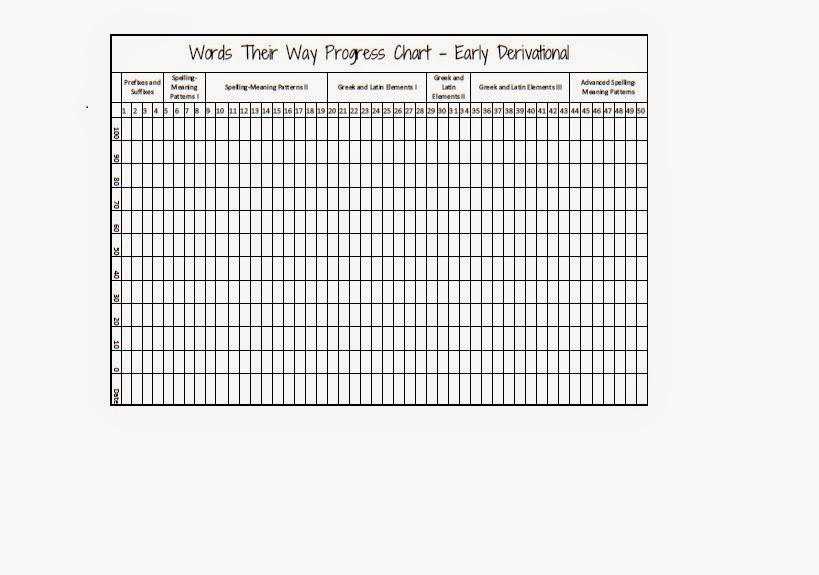
I also made up a progress chart for one set of sorts. I found some good ones for Letter Name-Alphabetic sorts and Words Within Words sorts at this TpT store, but couldn't find one for my little friend who is working in Early Derivational sorts (yes, this is first grade!) So I made something very similar. This is for those of you looking for a way to keep track of your Words Their Way progress in Data Binders.

 WTW - Early Derivational Progress Chart
Sorry this isn't prettier...it's looks better in person!
Happy sorting!


Monday, August 4, 2014

I Can Statements - Math

They're finally here! The I Can statements for math are designed exactly like the ELA statements, except with a herringbone pattern instead of polka dots. The math standards contain far fewer actual standards and most are closely linked. Working on these statements really drove home the idea that Common Core is designed to replace our "mile wide, inch deep" curriculum with something that really lets students dig deep into the important understandings.

I also plan to make a set of I Can statements for the Standards for Mathematical Practice. I think want to design them to be displayed all at once, though, so I need to tinker with the format.

In the meantime, grab these during the Back to School sale! Use code BTS14.


TpT Sale!


Today and tomorrow is the Back to School Sale at Teachers Pay Teachers. My store is pretty tiny; I have two freebies and two (inexpensive) paid products. But hey, a sale is a sale and those two products (the I Can Statements and the Five-Minute Jar) are both 20 percent off.
Five Minute Jar

The Five Minute Jar is a set of little cards that you can pull out of a jar any time you have exactly five minutes to fill. This seems to happen to me all the time. Something will wrap up five minutes before we have to get ready to be somewhere else, which is too much time to just leave early, but not enough to get involved in anything else I have planned for the day.

On each card is a question for which all the students will have an answer. Some link back to what you might be teaching, others touch on social skills, and others are just for fun.  It's also editable so you can make it work for what you need. I usually take answers for as long as I can, then let everyone tell their partner when we run out of time, so they all have time to answer. And today and tomorrow, it's only 80 cents!

While you're shopping, you should check out this store, where I just got some awesome writing rubrics and higher-order thinking math activities that I hope to use for Daily 3 math in the math journals. She has amazing stuff!


Friday, August 1, 2014

Five for Friday! {with a freebie}

Linking up with Doodle Bugs again for Five for Friday. Let's roll!


By Friday night last week I had both my new laminator and color ink in my possession. So I did what any young, energetic person with an exciting life does on a Friday night. I stayed up until (almost) midnight printing, laminating and cutting. I got some awesome goodies from A Sunny Day in First Grade and First Grade Fairy Tales, plus I finally got to print and hang my "I Can" statements!


Reading Literature and Informational Text standards near the CAFE menu.

Reading Foundational Skills near the word wall and some of the Word Work choices.


I also have a writing bulletin board where I hung the writing standards, but somehow my phone purged that photo. Still trying to figure out where to hang the Speaking/Listening and Language standards. I may split the Foundational Skills standards into even smaller groups so I can post certain standards near the word work students do to reinforce them.

I use these little magazine holders from IKEA for book boxes for Daily 5. They definitely are not as sturdy as plastic ones but are much cheaper and easier to find. I bought all the plastic ones on sale at Target today for $3 -- they only had six! And they don't seem to sell them except during back to school season. My amazing paraprofessional spent a ton of time reinforcing them with colorful duct tape. A lot of them held up really well, others needed more reinforcing at the end of the year. They had been taking up an entire countertop, so I bought these white shoe shelves at Target. They are $14 but you can get them for $12 with Cartwheel. I needed three to hold 25 book boxes. In case you're wondering if they are strong enough to hold an average sized woman while she hangs something up high...

they're not. Thank goodness for Cartwheel.

Added plus, they give me two extra sets of shelves below for storing Daily 3 math stuff, and I have that whole countertop to do...something with.


This year will be my fourth year teaching. Where I am, that means I have been pink slipped three times. This past year went a lot better than the others because I got rehired before the year was out. It's been amazing to have the end of the year and the whole summer to get ready for next year. And truth be told, my (fantastic) classroom paraprofessional did a ton of the work at the end of the year. The biggest project was a class set of OWL binders!

Cover
 

Rules and guidelines.

I can't take credit for the idea. The other first grade teacher and her former colleague had been doing these for years before I came along. She gave me everything she used, and I just put my own little twist on it.

Making these last summer was how I got really indoctrinated into the notion of an organized classroom. I always figured I was pretty organized, or organized enough. But these blew my mind.

They have a zippered pencil pouch, the planner that the school buys, and a homework folder. Then there are two sections in the back set off by cardstock dividers. One is for all the various calendars (behavior, reading, snack), the other is for sight words, quarter by quarter. And everything is labeled with freaking labels.

The kids have exactly one thing to pack up every day. The parents have exactly one thing to check every night. I have exactly one thing to check every morning. It has revolutionized a lot of what I deal with and don't have to deal with day to day. I am now debating what to have the kids do first thing in the morning while I stamp. What do you do to start the day?

Being at home for the summer never fails to impart some domestic lessons. Among these:

  • Krazy Straws that go through the dishwasher cease to be Krazy.
  • If the living area of your house is 50% carpet, and your cat coughs up a hairball five days a week, the hairball will be found on the carpet roughly 100% of the freaking time.
  • If rain doesn't fall from the sky without provocation, you must actually step onto your deck and water your plants. 
  • On the scale of difficult tasks, vacuuming a living room bursting with tiny plastic food, a rainbow of Duplos, and Thomas the Tank Engines of every possible size falls somewhere between alligator wrestling and nuclear fusion.

You made it to the freebie! Three cheers for stamina.

My district does Continuous Improvement/Quality Tools. The gist of it is that students are aware of and accountable for their own achievement. One of the ways we promote and track this is through Data Centers. 

A Data Center is a bulletin board with charts where your class tracks its achievement on various measures. Last year I had four charts: behavior, math assessments, weekly spelling tests, and reading (sight words). My room is owl themed (can you believe it?!) so these charts are too.


It's all in Google docs for you to play with.
The math chart is based on a 20 unit schedule. This is my master plan for next year, though I confess being frightened. Another teacher in my district has made some amazing assessments for each of these units, and you should really check out her blog while you're at it.

First Grade Common Core Math Assessments Bundle


Have a fabulous weekend!


Mrs. F-W

Tuesday, July 29, 2014

How do you teach math? I, We, You vs. You, Y'all, We

Math is a touchy subject for me. I excelled in math in school -- until I didn't. Our district let students skip ahead a grade in math if we did well, even to the point of busing us to the middle school and the high school when we were in 6th and 8th grades. So when I started floundering as a freshman in what my school called Honors Algebra 3-4, I fell off the honors math track and had trouble landing anywhere. I'll spare you the dull details of my circuitous journey through my school's tracked math courses and just sum up by saying I (and my parents) could not understand why math was a snap for me for nine years, and then I suddenly started failing.

I began piecing together what might have happened nearly 15 years later when I was taking my math pedagogy course. In my late twenties I was finally learning the concepts behind all those algorithms that only got more confusing with each year. The class was amazing and it left me with a lot of big ideas about how I wanted to do things in my classroom once I finally had one. Teaching concepts, then letting the algorithms reveal themselves as students honed their own problem solving strategies.

But when I did finally get a job, the students had already been in school for three days. I had to hit the ground running, so I started from square one with the district curriculum, branching out and adding on little by little as I got more comfortable. When I moved to first grade last year, I did the same. I was essentially winging it in my ELA curriculum by stepping away from our lackluster language arts curriculum and teaching CAFE and Daily 5. So I leaned on the math curriculum once again, which was quite a bit different in the primary grades.

Math became my least favorite time of day. Each lesson was set up with a math meeting/calendar time (which I was able to do my own way), fact practice that ate up a ton of time, a very teacher-centered scripted lesson, and "guided practice" that was a big worksheet we all did together. The students struggled to stay with me through the whole thing as I struggled to differentiate my instruction and cram everything in to the hour or so we had for math each day. That hour fell between lunch and specials (art, music, library, PE) that took us right up to dismissal, so nobody was exactly bursting with energy at that point either.

I am resolving to start anew this year, to teach concepts and to structure my math block like my literacy block: with time for independent and cooperative learning, and for differentiated instruction with strategy groups. I am mining EngageNY and other resources for lesson plans and trying to learn as much as I can about Daily 3 math. If you have experience with either, I'd love to hear about it. I also read this yesterday:

Why Do Americans Stink at Math? By Elizabeth Green for the New York Times.
The headline is a little bit of clickbait, to be sure, but the story is fascinating. A teacher in Japan revamps his instructions based on the recommendations of a consortium of educators in America. It's referred to here as "You, Y'all, We," meaning students are given a problem to grapple with, to give them an opportunity to apply what they already know (You). Then they share their thinking with groups or partners and compare notes (Y'all). Finally the class discusses the solutions as a whole group (We). 

This is contrary to the popular (old-fashioned) method like the one my curriculum uses, referred to as "I, We, You." The teacher demonstrates how to solve a problem (I). The class tries the teacher's methods with support from the teacher or other students (We). The students work independently -- this is a large chunk of the instructional time that mainly boils down to practicing a series of similar problems (You). 

The teacher trying the You, Y'all, We method goes on to get amazing results and trains other teachers who experience similar results. Then he comes to teach in America, only to find that we (American teachers) are using none of these same methods. Why? The sources in the story posit a few ideas: uneven training, turnover, unclear expectations for teachers. The recommendations are from NCTM, or the National Council of Teachers of Mathematics, which has been busy since the 1980s coming up with these ideas.

Obviously, Common Core State Standards have a much broader reach. Unless you are in one of the two states that haven't adopted them, they are a big part of your professional life right now. I think Common Core, especially the Standards for Mathematical Practice, ought to reinforce this type of teaching. But, as the article point out, it's suffering from some serious implementation issues. Teachers all over the U.S. are being asked to develop their own curriculum with very little guidance. OK. I think we are capable. But if our new curriculum is to represent a serious shift in how we teach, we need to clearly understand what it should look and sound like. Anyone, whether it's a large producer of educational materials or a teacher with a TpT store, can say that their materials are aligned to the Common Core. Slapping that label on it doesn't make it so. Just because a lesson, product, or "activity" touches on some of the ideas in the standards doesn't mean it represents meaningful instruction or creates real opportunities for learning.

How do we shed the skin of teacher-centered, dull lessons and meaningless busy work? What type of support do teachers need to put these practices into action? What has worked for you in your classroom?